
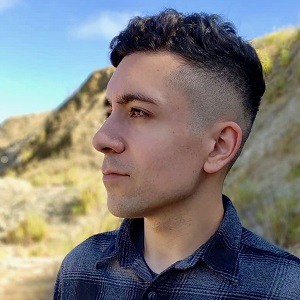
Abel Gomez
Department of Religion, Syracuse UniversityLineages of Abel’s family migrated from Nicaragua, El Salvador, and Mexico to the San Francisco Bay Area, the traditional territory of the Ohlone peoples.
Abel’s dissertation examines place-based belonging and movements to protect sacred sites by diverse Ohlone tribes of the San Francisco-Monterey Bay Area, even as they are without federal recognition and their territories are sites of major urban centers, migration, and gentrification. Drawing on ethnographic research and insights from religious studies, anthropology, geography, and Indigenous feminisms, Abel’s research engages the meaning of land as a site of ceremony, belonging, political activism, and futurity. These lands embody what Charles Long (1999) describes as “orientation in the ultimate sense,” sites of profound existential meaning.
Abel’s dissertation argues that to varying degrees, these lands are also sites of spiritual presences, transnational relationships, and contested narratives where Ohlone peoples participate in what Mishuana Goeman (2013) describes as “(re)mapping” of traditional and contemporary land relations. Such analysis seeks to support contemporary political movements to protect sacred sites in Ohlone territories such as the burial site at the West Berkeley Shellmound led by the Confederated Villages of Lisjan Ohlone and work of the Amah Mutsun Tribal Band to defend a ceremonial site called Juristac. In the wake of Standing Rock and Mauna Kea, Abel’s dissertation also situates Ohlone sacred sites protection efforts in the context of global indigenous movements defending land, water, and culture.
Abel earned a BA in philosophy and religion from San Francisco State University and an MA in religious studies from the University of Missouri.
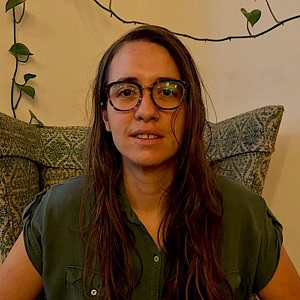
Isabel Gil Everaert
Department of Sociology, City University of New York, Graduate CenterIsabel is interested in broader understandings of the impacts of restrictive migratory policies in the lives of asylum seekers, refugees and migrants. Her work focuses on the experiences of Central American migrants and refugees in Mexico, her home country.
As conditions in Central America deteriorate, more and more people have left their homes, in many cases, fleeing life-threatening situations. This situation has led to the consolidation of a narrative of a migrant and refugee crisis. This, however, has not led governments in the region towards policies aimed at protection, inclusion, and social justice. Instead, discourses of crisis have become the backbone of increasingly restrictive migratory and asylum policies, aimed at managing and controlling migratory movements, along with a systematic violation of human rights and deterrence strategies that deny protection to refugees. Drawing on extensive ethnographic fieldwork in a strategic site in Mexico’s southern border with Guatemala, Isabel’s dissertation uncovers unexplored dynamics between mobility, time, and power.
Through a comprehensive empirical analysis of this reality, her research has three main objectives. First, to contribute to current scholarly discussions on mobility/immobility, migration, refugee and human rights, power and inequality. Second, to engage in methodological explorations of and debates over how to study these mobile populations in a way that is ethical, systematic, and broadly sociologically relevant. Third, to engage with debates on who has the right to move and who doesn’t, as well as of who controls these movements and in what ways.
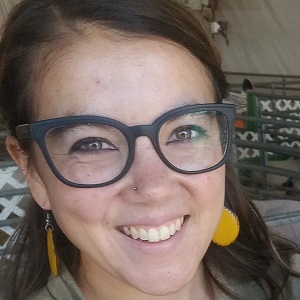
Elizabeth Hanna Rubio, PhD
Assistant Professor, Department of Gender and Sexuality Studies, University of California, RiversideElizabeth’s dissertation, “Contentious Solidarities,” explores how undocumented Korean American organizers conceptualize and navigate solidarity building with Black and Latinx counterparts as they develop visions for immigrant justice that extend beyond legalization and other forms of state recognition.
Responding to the rapid growth of undocumented Korean and other Asian American populations in the US, Korean Resource Center (KRC) and the National Korean American Services and Education Consortium (NAKASEC) have become influential players in the Southern Californian and national immigrant justice movements, respectively. Yet Korean Americans’ complex positioning in U.S. racial imaginaries as both victims of white supremacy, and beneficiaries of anti-Blackness gives rise to discursive, ideological, and material contradictions in KRC and NAKASEC’s work.
The resurgence of more overt forms of white supremacy, urgent calls to center anti-Blackness in racial justice work, and social media’s role in mainstreaming and intensifying debates about effective anti-racist praxis combine to create urgent re-conceptualizations of what constitutes a “progressive” stance, and by who and for whom such stances should be elaborated. Based on over two years of ethnographic fieldwork in Southern California, New York City, and Washington D.C., “Contentious Solidarities” follows KRC, NAKASEC, and the organizers with whom they ally and diverge to show how progressive Korean Americans navigate and respond to the contradictions that arise from shifting conceptualizations of racialized power and privilege.
A decade of organizing in national and local immigrant justice movements motivated Elizabeth to examine the internal racialized politics of immigrant justice worlds and the ways racialization informs how different organizers conceptualize justice for immigrants. A lifetime of navigating her identity as a mixed-race Korean American informs her exploration of the racialized contours of immigrant justice work.
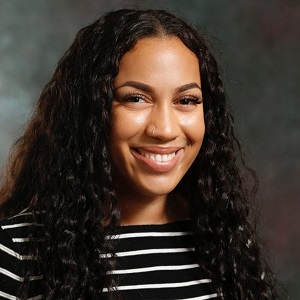
Sadé Lindsay, PhD
Assistant Professor, Department of Public Policy and Sociology, Cornell UniversitySadé’s research interests broadly include racial inequality, prisoner reentry and employment, incarceration and health, and drug use and policy.
Her dissertation, Effects of Contradictory Signals on Post-Prison Labor Market Outcomes, draws on a field experiment conducted in five states and 100 qualitative interviews with employers and formerly incarcerated men to examine whether and how certifications obtained in prison programs reduce stigma and discrimination experienced by returning citizens in the labor market. Her dissertation has received an award from the American Society of Criminology’s Division on Corrections and Sentencing and is supported by the National Science Foundation’s Sociology Doctoral Dissertation Improvement Grant.
Sadé’s dissertation research is informed by her direct service to incarcerated youth. She spent three years preparing young men in a juvenile correctional facility for reentry through financial and career goal planning and resume-building activities in addition to other activities on fatherhood, education, and health and wellness. Sadé continues work and advocacy surrounding issues of incarceration and reentry through her involvement with local reentry organizations and coalitions.
Sadé received her bachelor’s degree in Criminology and master’s degree in Sociology at the Ohio State University in 2015 and 2017, respectively. She is a Ruth D. Peterson Fellow of the American Society of Criminology, a Center on Democracy and Organizing Fellow, and an Academy of Criminal Justice Sciences’ Doctoral Summit Scholar
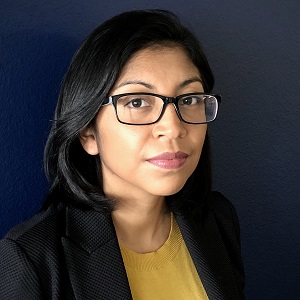
Lucia Leon, PhD
Assistant Professor, Department of Latino Studies and Social Justice, Dominican University of CaliforniaLucia Leon grew up in Orange County, California where she began organizing with undocumented youth and their families in the mid-2000s.
Her commitment to social justice and research interest on migration is profoundly shaped by her family’s experience with the family reunification process and her own political and intellectual trajectory as an undocumented immigrant of nearly 20 years. Her dissertation, “Intersectional Illegalities: Latina/o Undocumented Young Adults and the Marriage-Based Legalization Process,” combines a legal consciousness and intersectional framework to examine how discrete, yet intersecting markers of race, gender and sexuality interact to shape the legalization process for undocumented migrants in Los Angeles, California. Her research provides an empirical examination of a high stakes process to demonstrate how young adults interpret, comply with, or challenge a complex immigration system that can propel them into a path to citizenship or further their vulnerability for detention and deportation.
Lucia is currently co-creating a collaborative and community space with fellow scholars of migration through the founding of the Undocumented and Formerly Undocumented Migration Working Group. Through multi-authored papers, projects, and gatherings the workgroup addresses the unique challenges in the research process for current and formerly undocumented scholars who draw on their experiences with migration when theorizing and working with undocumented communities.

Micah Khater, PhD
Assistant Professor, Departmet of African American Studies, University of California, BerkeleyMicah Khater’s dissertation, "'Unable to Find Any Trace of Her’: Black Women, Genealogies of Escape, and Alabama Prisons, 1920–1950,” examines how black women negotiated encounters with and contested the violence of the carceral state by running away from prisons, jails, and police. She came to her work after finding a series of fragile twentieth-century prison escape notices stored at the Alabama Department of History and Archives. Her involvement in prison abolition guides her project and informs how she thinks and writes about carceral spaces.
Khater’s dissertation sits at the juncture of carceral state studies, social history, cultural studies, and black feminist theory. Using a broad range of archival sources—including handwritten letters, fire insurance maps, jail records, escape notices, bureaucratic correspondence, newspaper articles, court dockets, photographs, and architectural drawings — Khater’s work centers black women’s attempts to reclaim social identities in the “free world.” Her project identifies the act of running away, or transgressively moving through space, as both a rhetoric of protest and an articulation of desire. In this way, “‘Unable to Find Any Trace of Her’” renders alternative narratives of insurgency that acknowledge how kinship, grief, longing, and loss were always bound up with resistive action.
Khater's work has been supported by the Center for the Study of Race, Indigeneity, and Transnational Migration; the Gilder Lehrman Center for the Study of Slavery, Resistance, and Abolition; and the Frances S. Summersell Center for the Study of the South, among others. She earned her B.A. in History and French from North Carolina State University in 2015.