
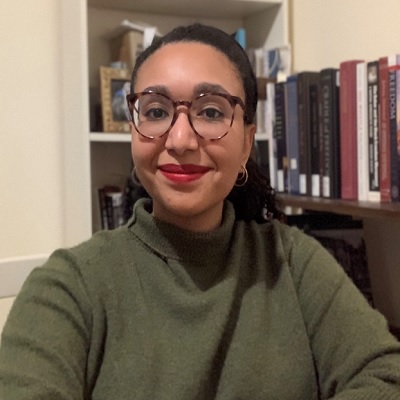
Micah Jones
Departments of History and African American Studies, Yale UniversityMicah Jones' research is situated at the intersection of the fields of African American History, Southern History, Black Women’s History, Social Movement History, and 20th Century United States social and political history.
Jones’s dissertation, “Jim Crow Prerogatives: Race and Consumption in the South, 1890-1980,” explores the ways Southerners’ experiences of food shopping varied according to race, and that Southerners’ experiences of race varied according to the way they shopped for food. Grocery stores have long been and remain sites of high-profile racial conflict, from the murder of Emmett Till to the murder of George Floyd. This project aims to understand why, by exploring the duality of consumption as both a mode of extracting resources from Black communities and a tool of anti-racist protest.
Prior to pursuing her Ph.D. at Yale, Micah completed her B.A. in History and African American Studies at Yale in 2016.

Brian Walter, PhD
Assistant Professor, Department of Anthropology, James Madison UniversityBrian Walter completed his dissertation in 2023 at the University of California, Santa Cruz. He is currently an Assistant Professor in the Department of Anthropology at James Madison University.
Brian’s research explores how the impacts of climate-change-driven sea-level rise are racialized and compounded by infrastructure and heritage preservation in the South Carolina Lowcountry. The Lowcountry is a region constituted by slavery and the tidal flow of water. With four consecutive years of hurricanes and 89 days of tidal flooding in Charleston in 2019, the Lowcountry’s relationship with the ebb and flow of tides remains central, though it now figures as a harbinger of future destruction. However, as local governments forge new tidal relations by building and adapting infrastructure, enduring racial geographies are revealed in the preservation of antebellum heritage landscapes and the everyday flooding of Black communities, many of whom are located on low lying former plantation lands.
Brian’s dissertation offers new formulations of coastal resiliency, while laying out empirical information backing activists and environmental justice organizations in the Lowcountry and their urgent and valid claims for reparative flood mitigation for their communities.
He is collaborating with South Carolina flood activists and environmental justice advocates. Brian received his BA in Anthropology and Philosophy from the Honors College at University of Georgia, and his MA in Cultural Anthropology from the University of California, Santa Cruz

Jennifer Standish, PhD
Jennifer Standish studies the social, legal, and political history of labor unions in the 20th century U.S. South. Her dissertation focuses on the history of “Right-to-Work” laws and union security agreements. Union organizers argue that these laws create a “free rider” problem, disincentivizing union participation and draining unions of their members, finances, and potential to strike. She is currently exploring how early iterations of these laws were rooted in agricultural industries and WWII labor coordination and management.
Jennifer’s master’s research focused on how Jim Crow laws—and their formal dissolution in the 1960s—shaped labor solidarities. Witnessing workplace surveillance, racism within and outside of labor organizing, and legal restrictions on worker activism in her own workplace cemented her interest in studying legal constraints to worker organizing on and off the job.
Jennifer received her B.A. from the University of Chicago in 2015. As a graduate student, she has enjoyed teaching undergraduate students in the history department and through the Southern Oral History Program. Her pedagogical interests extend beyond the college level, and she has been lucky to also work with North Carolina educators and teachers on K-12 curriculum development for U.S. history.

Eshe Sherley, PhD
Assistant Professor, Department of African American Studies, Wake Forest UniversityEshe Sherley is also a member of the Certificate Program in Women’s and Gender Studies at the University of Michigan.
Her dissertation, “Care in Crisis: Black Women and the Politics of Labor in Atlanta, 1965-1985,” examines how working-class Black women organized themselves in domestic worker unions, welfare rights organizations, and as prisoners and mothers to challenge the politics of austerity and to advocate for policies that would value both their waged and unwaged caring labor. Her work has been supported by the National Center for Institutional Diversity and the Institute for Research on Women and Gender at the University of Michigan.
Eshe is a recipient of the 2021 Reed Fink Award in Southern Labor History from Georgia State University. She holds an M.A. in History from the University of Michigan and a B.A. in African American Studies from Yale University.

Bruno Seraphin, PhD
Assistant Professor, Department of Anthropology, University of ConnecticutBruno Seraphin completed his dissertation at Cornell University in 2023. He is currently an Assistant Professor in the Department of Anthropology at the University of Connecticut.
Bruno is also a graduate minor in American Indian and Indigenous studies. His research focuses on environmental and climate justice movements in the U.S. northwest, imperialism and militarism, and film methodologies. His dissertation examines the politics of wildfire and prescribed burning in Karuk aboriginal territory in the unsettled colonial present.
As wildfires throughout the U.S. west intensify, Indigenous fire practitioners fight for sovereignty and survivance while navigating between, on one side, a militarized firefighting apparatus premised on the settler state’s entitlement to environmental authority, and on the other side, a broad-based colonial impulse to appropriate and commodify Indigenous knowledge. Through participant observation, collaborative filmmaking, and interviews, Bruno’s dissertation tracks how settler colonial relations of power and property can be reaffirmed or disrupted by the increasing frequency of environmental crises. A committee of Karuk cultural practitioners advises on the work.
A settler raised on occupied Nipmuc land in Massachusetts, Bruno is an award-winning filmmaker with a BFA in film from New York University and an MA in folklore from the University of Oregon. Bruno’s project has received support from the Wenner-Gren Foundation and Cornell’s Reppy Institute for Peace and Conflict Studies.

Nora Kassner, PhD
Lecturer, Program in Writing and Rhetoric, Stanford UniversityNora Kassner (she/they) is a doctoral emphasis in Feminist Studies. Her dissertation, titled “Hard to Place: Queer Foster Families and the Remaking of U.S. Family Policy, 1975-1996,” explores the transformation of U.S. family policy in the late 20th century through the experiences of queer foster parents and their foster children.
As the first historical study of queer people in the U.S. foster system, Nora’s dissertation provides a unique lens into the debate over the transformation of the American family. Drawing on original oral history interviews and archival resources, they examine the processes by which shifting notions of race, sexuality, and disability remade American foster care and American family policy more broadly. Nora’s work has been supported by the WW Doctoral Dissertation Fellowship in Women’s Studies from the Institute for Citizens & Scholars, the ONE Archives Foundation, and the University of California-Santa Barbara.
Prior to attending graduate school, Nora worked as a community organizer, and a commitment to publicly-engaged scholarship remains central to their work. Nora received an MA in history from University of California, Santa Barbara and a BA in Classics from Macalester College.